A DVSA examiner asks for three months of walkaround checks. A Traffic Commissioner asks how you knew that driver’s licence was valid on the day he drove. An insurer asks who signed off the brake test.
You don’t need to explain. You need to produce it.
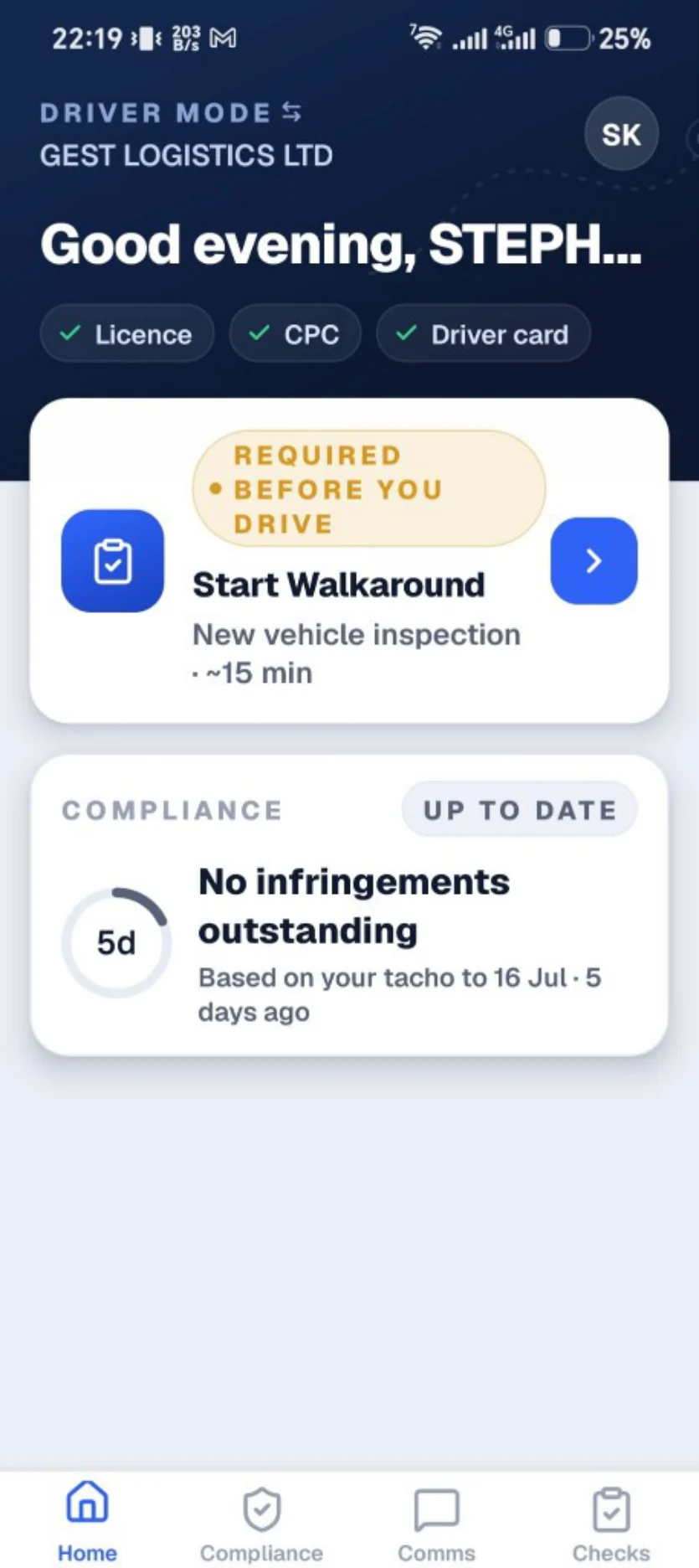
Not two days of reconstructing records from memory because the DVSA asked for them.
One app, iOS or Android. It replaces the folder in the cab and the pad nobody fills in properly.
Daily checks with photo evidence. Wheel checks, solo trailer checks, border checks. Nil defects recorded, not assumed.
Licence, tacho card and CPC expiry, visible to him. Drivers argue less with a screen than with a manager.
For tacho-exempt drivers — the group everyone forgets until someone asks for their records.
His tachograph activity, his infringements to review and sign, in his hand.
Bump card, H&S incidents, near misses. Reported while he still remembers it.
Logged with the receipt photographed at the pump, not found in a coat pocket weeks later.
Everything you’ve written down, in his pocket — so “I was never told” stops being available.
Message every driver, or one driver, with attachments. Read status recorded.
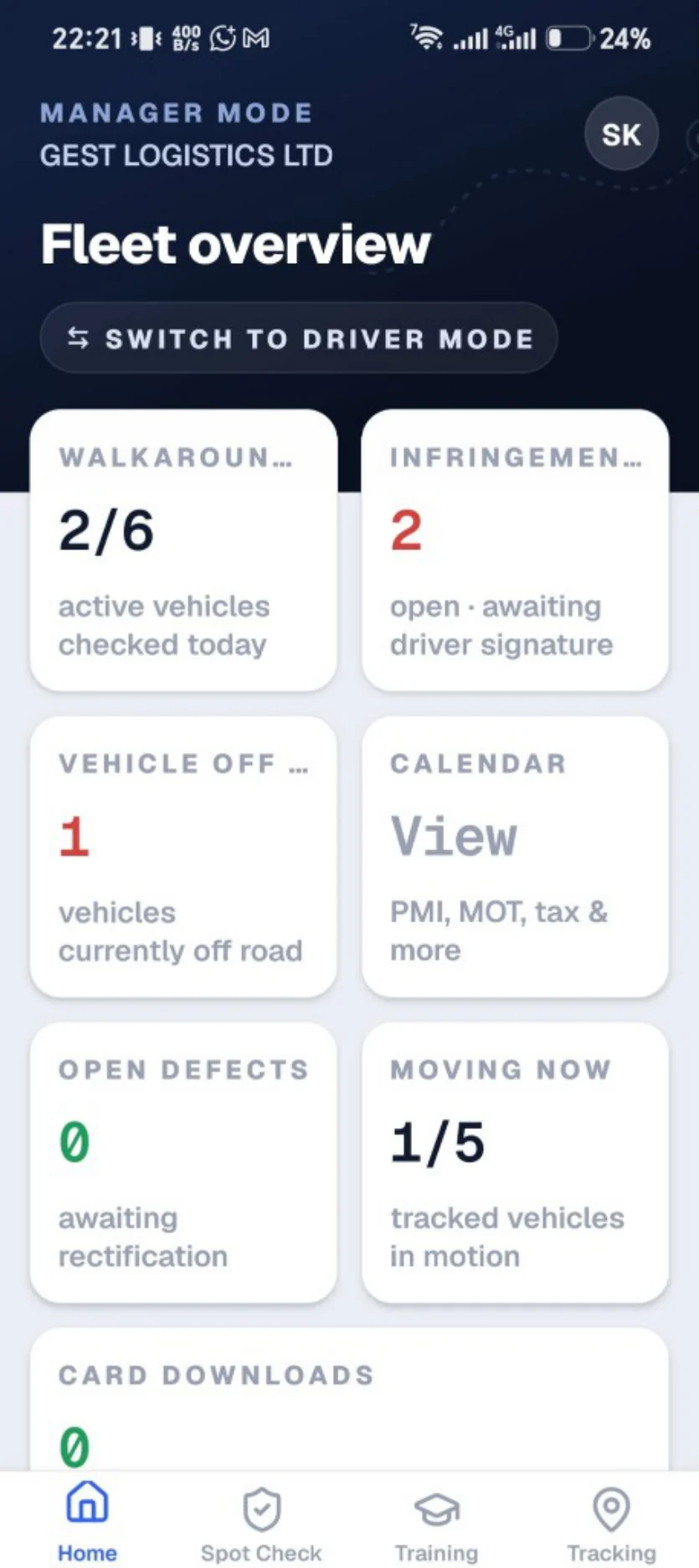
Not a dashboard for its own sake. The five things that keep you awake:
Plus the forward planner — PMI, MOT, RBT, calibration — spot and gate checks, training logs and vehicle tracking.
This is the part operators underestimate.
MOT, VED and manufacturer recall data straight from DVSA. Nobody re-keying dates into a spreadsheet.
Run automatically, with somewhere to record the work when it is done. Most operators do not check recalls at all — it is a straightforward question at a Public Inquiry and a bad one to fumble.
Inspection intervals worked out for you, with the document produced.
Email the moment a driver reports a defect, or a maintenance event falls due.
Not just where you are — a Green Status plan and predictor showing what it takes to get there.
When the DVSA want walkaround sheets or PMI sheets, that is the whole job.
An agency driver turns up at six in the morning. He gets an immediate licence check and a basic induction, automatically, before he touches a vehicle. That is the gap that shows up in a PI transcript.
Not just storing the sheet — evidencing that someone competent looked at it and made a decision. The difference between having records and demonstrating control.
Tracked through to resolution, with the training need identified and recorded against the driver.
Three levels, with an optional annual questionnaire.
The material used, the content covered, and the driver’s signature against it.
Test your operation against the DVSA ER standard whether or not you are registered. The closest thing to marking your own homework honestly.
Checks completed today. Rushed walkarounds. Vehicles missed. Driven without a walkaround. PMI, MOT, tax, tacho calibration and RBT due. High-risk drivers. Recalls. You do not go looking for any of it — it is simply there when you sit down.
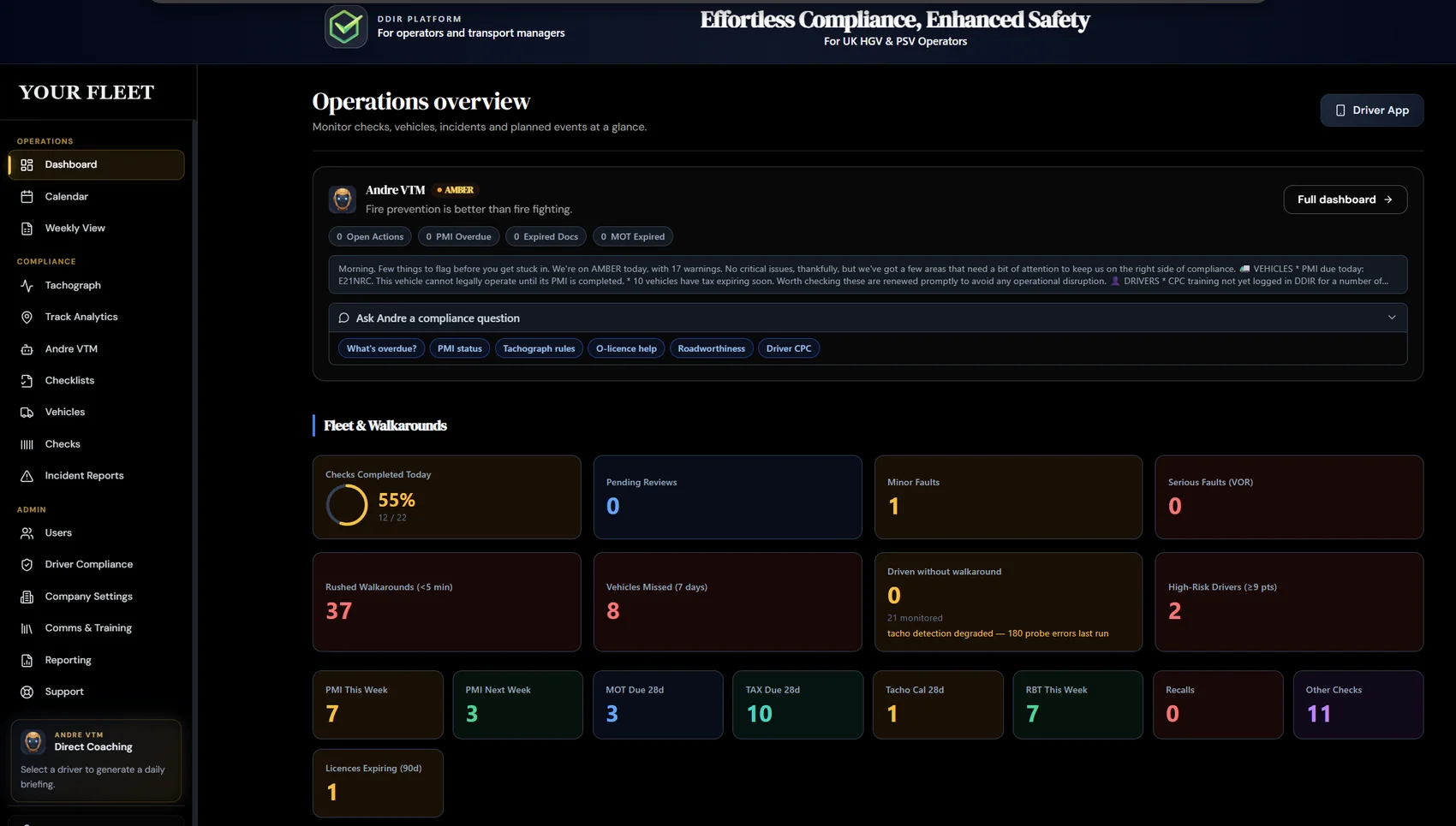

An AI virtual transport manager who watches the operation between your visits, flags what is drifting, and answers questions when you are not sure.
He does not replace a transport manager. He stops things going quietly wrong in the gaps.
£52 a year, per vehicle. A ten-vehicle operator pays £520 a year — less than a single day of consultancy, and considerably less than one prohibition, one missed recall, or one afternoon spent reconstructing three months of walkaround sheets from memory because the DVSA asked.
You are not buying software. You are buying the ability to prove it.
Straight about the add-ons: driver licence checking, tachograph analysis and vehicle tracking are optional services that have to be enabled for your organisation before drivers see that detail. Everything else on this page is in the £1. We would rather tell you now than have you find out later.
 You're viewingDDIR Fleet App